One of these decisions is reversible by Friday. The other stays with you for life. That single difference matters more than anything else you will read about cheek augmentation, so start there.
Cheek filler is a 20-minute injectable appointment using hyaluronic acid. It lasts roughly one to two years. The good news is that it can be dissolved if you change your mind. On the other hand, cheek implants are silicone shells placed surgically over your cheekbones. The procedure takes place under anesthesia. It is permanent unless removed by another operation. Most people asking about cheek filler vs cheek implant want more definition without committing to surgery, which is exactly what filler was designed to deliver.
What Is Actually Happening in Each Procedure?
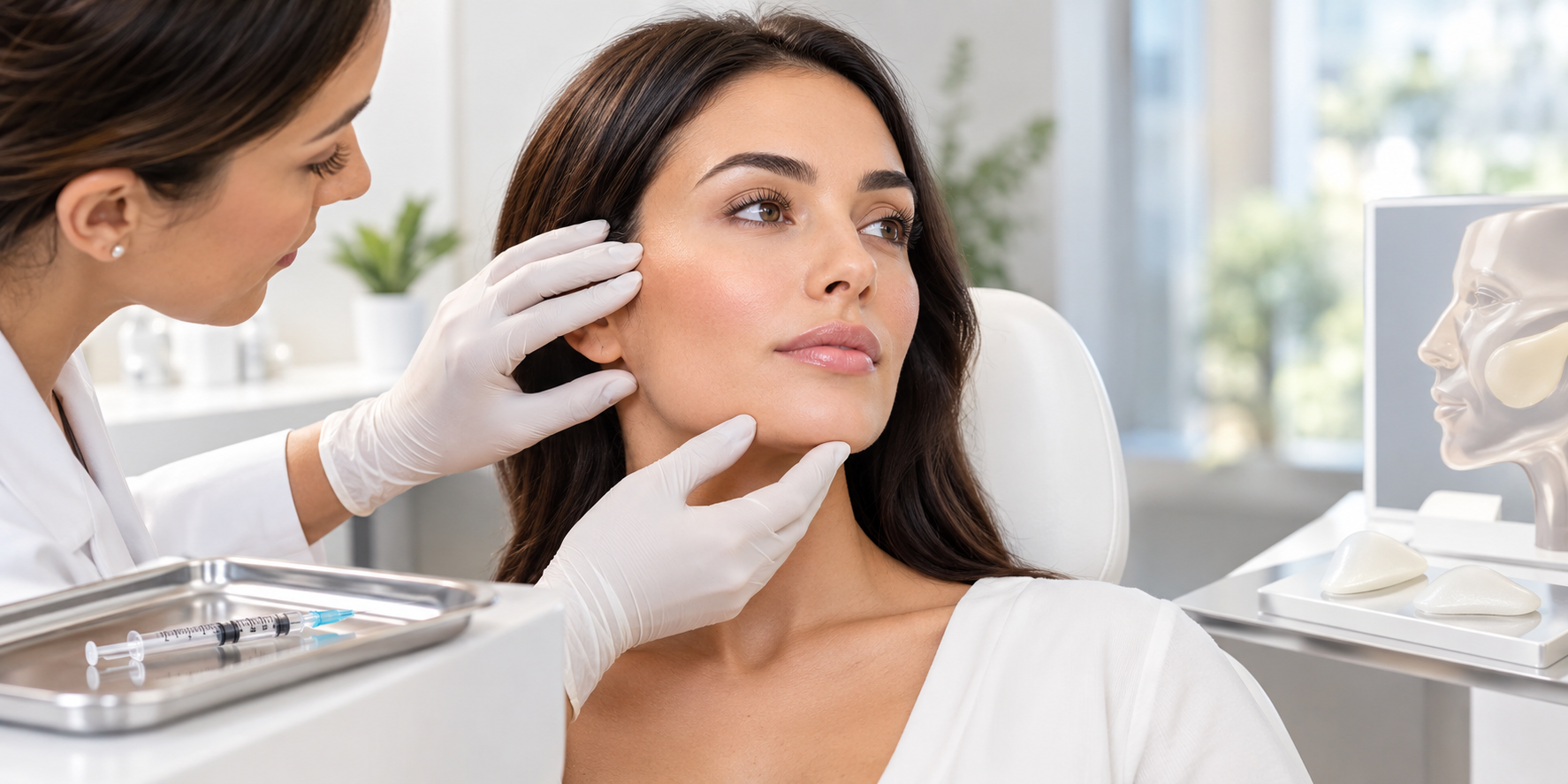
Cheek filler involves injecting a firm HA gel such as Juvéderm Voluma or Restylane Lyft deep against the cheekbone. This helps lift the midface and restore the fullness that flattens out after your thirties. You feel pressure rather than pain, and you see the result before you leave the room.
Cheek implants usually require an incision. The procedure is done through an incision inside the mouth. A solid implant is positioned over the bone and sometimes secured with a screw. Surgery takes around two hours under general anesthesia. The projection is permanent, since the implant never softens or migrates.
Who Is the Better Candidate for Cheek Filler?
Most people, honestly. Cheek filler suits you if:
- You have mild to moderate volume loss rather than genuinely flat bone structure
- You want to see how more cheek projection looks on your face before anything permanent
- Your schedule cannot absorb a week off work
- You are in your late twenties through your fifties and losing midface fullness gradually
- You want a treatment that can be dissolved within hours if the result is not what you pictured
- You would rather spread the cost over years than pay a surgical fee upfront
That fifth point deserves emphasis. Hyaluronic acid is reversible with an enzyme called hyaluronidase. Meaning, if you dislike the results, you don’t have to live with them forever. Very few aesthetic procedures offer that safety net.
When Do Cheek Implants Make More Sense?
Implants earn their place in specific cases. Patients with truly underdeveloped cheekbones, particularly younger men seeking strong skeletal definition, often need more structural projection than filler can produce without looking heavy. Anyone who has been maintaining large volumes of filler for several years might also find the arithmetic favours surgery eventually.
Facial reconstruction after trauma or congenital asymmetry sits firmly in surgical territory too. A good injector will tell you when your goals exceed what a syringe can achieve, and a good surgeon will tell you when you are better served by an injectable.
What Does Each Option Cost in Canada?
Cheek filler Canada pricing typically runs $600 to $1,200 per syringe. Most cheek treatments use two syringes for balance across both sides. Expect $1,200 to $2,000 for a full treatment. The results will last 12 to 24 months. Voluma tends to sit at the longer end because it was formulated specifically for midface projection.
Cheek implants in Canada run $4,000 to $10,000 depending on multiple factors. These include the surgeon, the facility, and whether anesthesia fees are bundled in. That figure covers a permanent result, so the comparison is never purely about the number. Maintaining filler for a decade costs more than one surgery. Maintaining it for three years while you decide costs considerably less.
What Should You Expect from Recovery?
This is where the two procedures separate most sharply.
After cheek filler:
- Mild swelling and occasional bruising for two to five days
- Back to work the same afternoon, makeup the next morning
- Final settled result at around two weeks
- No restrictions beyond avoiding intense exercise and heat for 24 to 48 hours
After cheek implants:
- Significant swelling and numbness for one to three weeks
- Roughly one week off work, with full recovery around six weeks
- A soft or liquid diet for several days when incisions are inside the mouth
- Final shape visible at three months, once deep swelling resolves
The non-surgical treatment wins on convenience by a wide margin. Surgery wins on permanence.
Can You Try Filler First and Choose Surgery Later?
Yes, which is why many surgeons recommend exactly that. Cheek filler works as a live preview of added projection on your own face. You wear the result for a year or two, learn whether you actually enjoy a stronger midface, and only then decide whether permanence is worth surgery.
The sequence works in the other direction too. Plenty of implant patients add small amounts of filler afterward to soften edges or correct minor asymmetry, since implants address bone structure while filler handles soft tissue.
Which One Should You Book a Consultation For?
Book the filler consultation first if you are undecided. An experienced injector will tell you honestly whether your goals sit inside or outside what dermal fillers can deliver, and knowing how added cheek volume looks on you makes any later surgical conversation far easier.
Cheek Filler vs. Cheek Implants at a Glance
| Cheek Filler | Cheek Implants | |
| Type | Non-surgical injectable | Surgical, under anesthesia |
| Appointment | 20 to 30 minutes | 1 to 2 hours |
| Results visible | Immediately, settled at 2 weeks | Immediately, settled at 3 months |
| Downtime | None to 2 days | About 1 week off, 6 weeks total |
| Duration | 12 to 24 months | Permanent |
| Reversible | Yes, dissolvable within hours | Removal requires further surgery |
| Cost in Canada | $1,200 to $2,000 per treatment | $4,000 to $10,000 |
| Best for | Volume loss, definition, trying the look | Flat bone structure, permanent projection |
| Adjustable over time | Yes, at every appointment | Fixed once healed |
Book a free consultation at 3D Lifestyle and find out what cheek filler can do for your face.